



Engineering Intelligence: From Integrated Data to Smarter Plant Design

Ajit Joshi
ITandFactory GmbH
Introduction
Plant engineering is becoming more complex. Projects involve more disciplines, more stakeholders, larger volumes of engineering information, and increasing pressure to deliver projects faster while maintaining quality and consistency.
At the same time, engineering organizations are being asked to make greater use of digital technologies, automation and, increasingly, artificial intelligence.
This raises an important question: What happens when engineering information becomes more connected, structured and intelligent?
I believe this is where the idea of Engineering Intelligence begins. It is not about replacing engineering expertise with technology. It is about creating an environment in which engineering expertise can work with better information, better context and more connected processes.
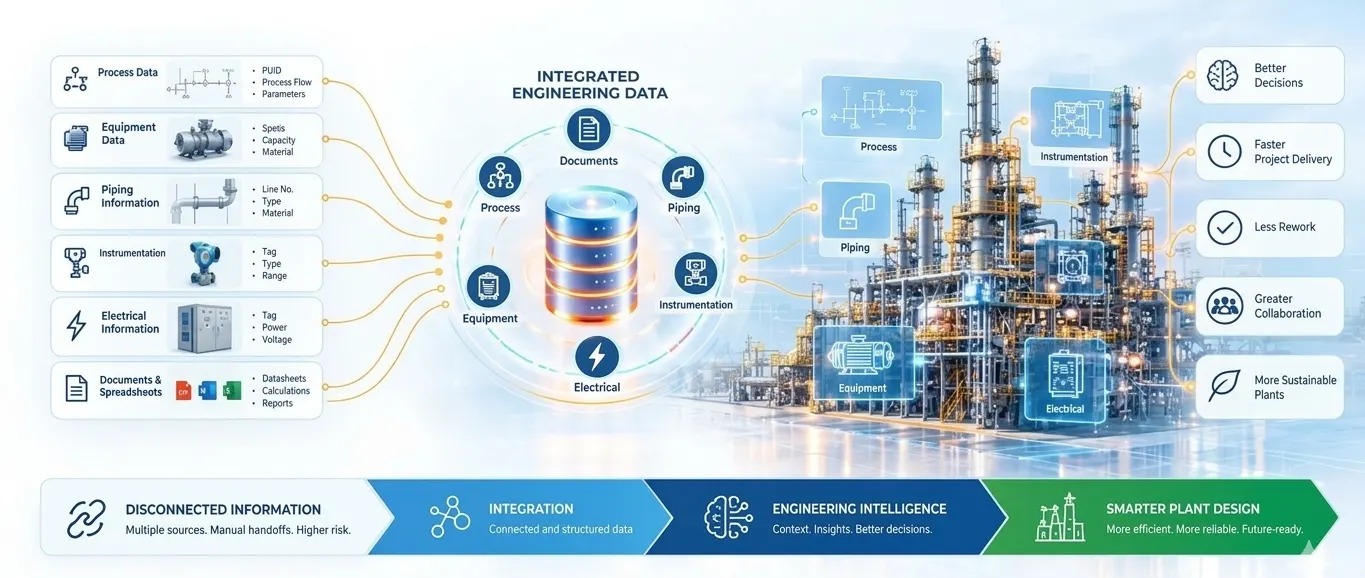
The journey starts with something fundamental: integrated engineering data.
From Digital Documents to Connected Information
Engineering has already undergone significant digitalization. Drawings that once existed on paper are now created, stored and shared digitally. But digital does not necessarily mean connected.
It is possible to have a completely digital engineering environment in which information is still fragmented across applications, files, spreadsheets and documents.
In such an environment, engineers may still spend significant time searching for information, checking whether data is current, transferring information between systems, and recreating information that already exists elsewhere.
The challenge is therefore no longer simply to digitize engineering information. It is to connect it.
When engineering information is structured and connected, it becomes possible to understand not only individual pieces of information, but also the relationships between them.
Why Integration Matters
Plant engineering is inherently multidisciplinary. Process, piping, mechanical, instrumentation, electrical and other disciplines do not work independently. Decisions made in one area can influence requirements and deliverables in another.
Consider a change to a piece of equipment. The change may affect process information, connected piping, instruments, electrical requirements, documentation and procurement information.
When these areas exist in disconnected information environments, understanding the wider impact of a change can require considerable manual effort.
When the underlying engineering information is connected, however, those relationships become much easier to understand.
Software integration connects applications. Engineering integration connects information, relationships and knowledge. The latter is where integration starts creating real engineering value.
Data Alone Is Not Enough
Having more data does not automatically make engineering more intelligent. The value of engineering data depends on its structure, context and relationships.
A pump, for example, is not simply a line in a database. It has a role in a process. It connects to piping. It may have associated instruments and electrical requirements. It may also appear in multiple engineering deliverables.
The relationships between these pieces of information are what provide context.
When those relationships are maintained, engineering teams can do more than store information. They can find it more easily, maintain consistency, understand changes, reuse engineering knowledge and support better decisions.
From Integrated Data to Engineering Intelligence
Engineering Intelligence, in my view, is the next step beyond simply having connected data.
It is the ability to use connected engineering information, context and relationships to support better engineering work.
This can include better access to engineering information, greater consistency across disciplines, better visibility into changes and their impact, less repetitive information handling, greater reuse of engineering knowledge, more effective automation, and better support for engineering decisions.
The important point is that intelligence does not replace engineering expertise. It strengthens it.
The Role of Automation
Automation is often presented as a way to make engineering faster. But speed alone should not be the objective.
The more important question is: what work should engineers no longer have to spend their time doing?
Searching for information, transferring data, checking repetitive information and recreating existing content can consume significant engineering effort.
Appropriate automation can reduce this unnecessary work. That gives engineers more time to focus on engineering decisions, problem-solving and the parts of a project where human expertise matters most.
Why This Matters for the Future of AI
Artificial intelligence is creating enormous interest across engineering and other industries. But meaningful AI assistance depends on the information available to it.
If engineering information is fragmented, inconsistent or difficult to interpret, the potential value of advanced technologies is constrained.
Structured, connected and contextualized engineering information provides a stronger foundation.
Engineering organizations that improve the quality and connectivity of their information today will be better positioned to take advantage of tomorrow's technologies.
AI may become an important part of the future of engineering. But the engineering data foundation needs to be ready first.
Smarter Plant Design Is the Outcome
Ultimately, the objective is not simply better data. It is better engineering.
Integrated information can support stronger collaboration between disciplines. Connected relationships can make changes easier to understand. Structured data can reduce unnecessary recreation and checking. Automation can reduce repetitive work.
Integrated information can support stronger collaboration between disciplines. Connected relationships can make changes easier to understand. Structured data can reduce unnecessary recreation and checking. Automation can reduce repetitive work.
That is what makes smarter plant design possible.
The value of Engineering Intelligence is therefore not measured by how much technology an organization has. It is measured by how effectively that technology helps people engineer.
Where Plant Engineering Goes Next
The evolution of plant engineering can be viewed as a progression:
Paper → Digital Documents → Connected Data → Automation & Engineering Intelligence → AI-enabled Engineering
Each stage builds on the previous one.
The next generation of engineering environments will not be defined by technology alone. They will depend on how effectively people, processes, information and technology work together.
Instead of asking only which new tools should be adopted, we should also ask whether the engineering information foundation is ready to support them.
Conclusion
Engineering Intelligence is ultimately about a simple idea:
- Smarter plant design begins with better-connected engineering information.
- Integrated data provides the foundation.
- Connected processes create the context.
- Automation helps reduce unnecessary effort.
- Engineering expertise provides the judgment.
- And emerging technologies, including AI, can build on that foundation.
The opportunity is not to make engineering less human. It is to make human engineering expertise more effective.
The question for engineering organizations is therefore not simply, “What technology should we adopt next?” It is also, “Are we building the engineering information foundation that will allow tomorrow's technology to deliver its full value?”
That, in my view, is where the journey from integrated data to smarter plant design begins.